
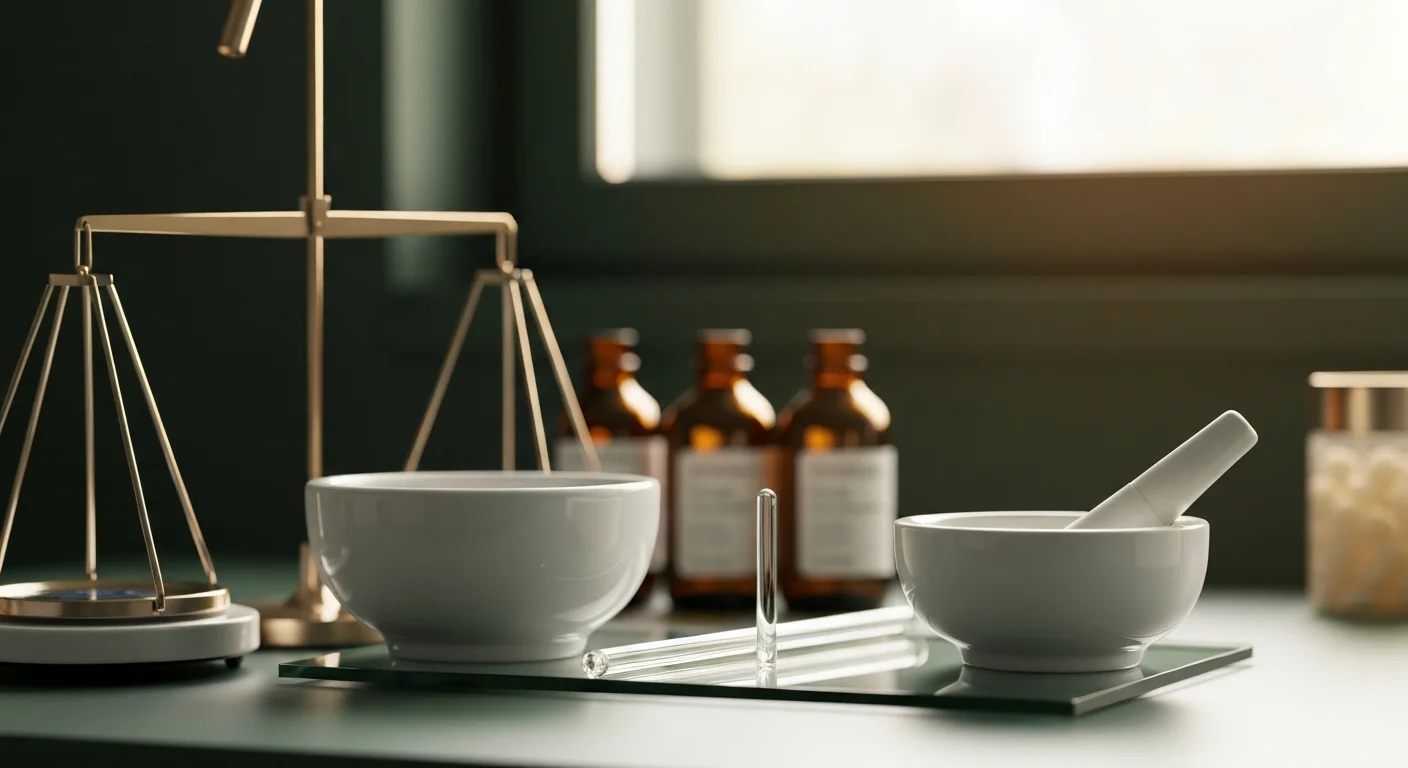
Custom Dermatology Compounds: Acne, Anti-Aging, and Hyperpigmentation Solutions
Commercial skincare products come in fixed strengths and formulas. Compounded dermatology preparations let your provider customize every ingredient, concentration, and base for your specific skin condition.
The short answer: compounded dermatology medications let your prescriber customize every variable, active ingredients, concentrations, combinations, and the base or vehicle, to match your specific skin condition, type, and tolerance. Where commercial products offer one-size-fits-all, compounding produces a formulation built for your skin. Common applications include acne, hyperpigmentation, photoaging, rosacea, and eczema.
KeyPoints
- Compounded dermatology preparations are prescription medications, not cosmetics
- Your provider controls every variable: ingredient, concentration, combination, and base
- Multi-ingredient formulations simplify routines, one cream instead of layering three products
- Common ingredients include tretinoin, hydroquinone, niacinamide, azelaic acid, and peptides
- Formulations are prepared under USP 795 standards with pharmaceutical-grade ingredients
EndKeyPoints
How does compounded skincare differ from commercial products?
Commercial dermatology products, whether prescription or over-the-counter, come in fixed strengths and limited combinations. Your options are whatever the manufacturer decided to make. Compounding removes those constraints:
ComparisonStart:Commercial vs. Compounded Dermatology
Commercial Products
Fixed strengths (e.g., tretinoin only in 0.025%, 0.05%, 0.1%). Single active ingredient per product in most cases. Manufacturer-selected base that may not suit your skin type. Contains preservatives, fragrances, or fillers that some patients react to. Limited to what is currently manufactured and in stock.
Compounded Formulations
Any concentration your provider prescribes (e.g., tretinoin 0.035% or 0.075%). Multiple active ingredients combined in one preparation. Base selected for your skin type, lightweight gel, rich cream, anhydrous ointment. Can be prepared without specific allergens or irritants. Made to order based on your prescription.
ComparisonEnd
What are the most common compounded acne formulations?
Acne is multifactorial, excess sebum, bacterial colonization, inflammation, and abnormal keratinization all play roles. Compounded acne treatments can address multiple mechanisms in a single application:
- Tretinoin (0.01–0.1%): normalizes keratinization, unclogs pores, and stimulates cell turnover. The cornerstone of most acne regimens.
- Niacinamide (4–10%): reduces inflammation, regulates sebum production, and strengthens the skin barrier, well-tolerated even by sensitive skin.
- Azelaic acid (10–20%): antibacterial, anti-inflammatory, and effective against post-inflammatory hyperpigmentation. Safe during pregnancy at concentrations below 20%.
- Clindamycin (1–2%): topical antibiotic targeting C. acnes bacteria. Often combined with tretinoin or benzoyl peroxide to reduce resistance.
- Spironolactone (3–5% topical): anti-androgen that reduces hormonal acne, particularly along the jawline and chin. Topical application reduces systemic effects compared to oral spironolactone.
- Dapsone (5–7.5%): anti-inflammatory especially effective for inflammatory and cystic acne in adult women.
A typical combination prescription might read: tretinoin 0.05% / niacinamide 4% / azelaic acid 10% in a lightweight gel base. One application with several ingredients, which can be simpler than layering three products.
What compounded options exist for hyperpigmentation and melasma?
Hyperpigmentation treatment often requires higher concentrations or combinations not available commercially. Compounded options include:
- Hydroquinone (2–8%): the most extensively studied tyrosinase inhibitor. Commercial products max out at 2% OTC; prescribers can order 4–8% compounded for resistant cases.
- Modified Kligman formula: hydroquinone + tretinoin + a low-potency corticosteroid, the classic triple-combination approach to melasma.
- Tranexamic acid (2–5% topical): inhibits plasmin-mediated melanogenesis. Increasingly popular for melasma patients who cannot use hydroquinone long-term.
- Kojic acid (1–4%): natural tyrosinase inhibitor, often combined with other brightening agents.
- Alpha arbutin (2–4%): slow-release hydroquinone alternative for maintenance therapy between hydroquinone cycles.
- Cysteamine (5%): antioxidant brightener for hydroquinone-intolerant patients.
What anti-aging compounds can a pharmacy prepare?
Compounded anti-aging formulations go beyond what commercial products offer:
| Ingredient | Concentration Range | Mechanism | Best For |
|---|---|---|---|
| Tretinoin | 0.01–0.1% | Stimulates collagen, increases cell turnover | Fine lines, texture, photodamage |
| Niacinamide | 4–10% | Barrier repair, anti-glycation, sebum control | Tone, pore size, overall aging |
| Vitamin C (stabilized derivatives) | 5–20% | Antioxidant protection, collagen support | Brightening, prevention |
| GHK-Cu (copper peptide) | 1–3% | Supports the look of firmness and elasticity | Fine lines, texture |
| Topical estriol | 0.3–1% | Improves thickness, hydration, collagen | Postmenopausal skin thinning |
| Hyaluronic acid | 0.5–2% | Humectant, moisture retention | Dehydration, surface plumping |
How does your provider choose the right base or vehicle?
The base matters as much as the active ingredients. It determines how the medication feels, how well it penetrates, and whether it suits your skin type:
- Lightweight gels: oil-free, fast-absorbing. Best for oily and acne-prone skin.
- Vanishing cream bases: elegant feel, moderate absorption. Good for normal-to-combination skin.
- Lipoderm or PLO bases: enhanced penetration through the skin barrier. Used when deeper delivery is needed.
- Anhydrous ointments: occlusive, maximal moisturization. Best for very dry, eczema-prone, or cracked skin.
- Silicone-based vehicles: smooth application, protective barrier. Often used for scar treatment formulations.
Getting compounded dermatology prescriptions in Los Angeles
Generation Pharmacy compounds prescription dermatology formulations for acne, hyperpigmentation, anti-aging, rosacea, eczema, and other skin conditions at our West Los Angeles pharmacy. Your dermatologist or provider prescribes the formulation; we prepare it under USP 795 standards, typically within 1–2 business days. Browse our formulation catalog, explore the ingredient library, or call 424-228-1049 to discuss a prescription with our pharmacists.
Frequently Asked Questions
What skin conditions can compounded medications treat?
Compounding pharmacies prepare prescription formulations for acne, hyperpigmentation and melasma, photoaging and fine lines, rosacea, eczema, psoriasis, fungal infections, scarring, and other dermatologic conditions. Each formulation is prepared per a prescriber's order with ingredients and concentrations made for the individual patient.
Is compounded tretinoin different from store-bought retinol?
Tretinoin is a prescription-strength retinoid; unlike OTC retinol, it doesn't need to be converted by the skin to become active. Compounding adds another layer: your provider can specify the exact concentration (0.01% to 0.1%), choose a base suited to your skin type, and combine tretinoin with complementary ingredients in a single preparation. OTC retinol does not require a prescription.
Can a compounding pharmacy make a custom acne cream?
Yes. Common compounded acne formulations include combinations of tretinoin, niacinamide, azelaic acid, clindamycin, dapsone, and spironolactone in a single topical preparation, concentrations and combinations set by your dermatologist based on your acne type and skin sensitivity.
How long do compounded dermatology creams last?
Under USP 795 guidelines, most water-containing topical compounds (creams, lotions, gels) carry a beyond-use date of 30 days. Non-aqueous preparations like ointments may last up to 90 days. Your pharmacy will label each compound with its specific beyond-use date.
Do I need a dermatologist to get compounded skincare?
You need a prescription from a licensed healthcare provider. This can be a dermatologist, primary care physician, nurse practitioner, or physician assistant. The prescriber determines the formulation; the pharmacy compounds it to their specifications.
Disclaimer: This content is provided for informational purposes only and is not intended as medical advice, diagnosis, or treatment. Always consult with a qualified healthcare professional regarding any medical condition or before starting any new treatment.
Related Articles
Compounded Peptides in 2026: What the FDA Panel Changed, and What a Non-Sterile Pharmacy Can Make Today
In July 2026 an FDA advisory committee recommended six peptides for the 503A list. None of them is legal to compound yet. Here is where each one stands, which peptides are components of approved drugs, and the non-peptide formulas prescribers are asking for most.
Compounded Testosterone: How Prescribing Works in California
Testosterone is a Schedule III controlled substance. Here is how a compounded testosterone prescription reaches a California pharmacy: who can write it, how it has to be sent, and why the pharmacy needs a DEA registration. Rx-only, prescriber-directed.
Understanding Hyperpigmentation and the Ingredients that Target it
Learn about the science behind hyperpigmentation and the ingredients prescribers use for different types of skin discoloration.